

They Don’t Need More Christian Content.

Our teens and young adults can Google Jesus. They can ask AI any question about Jesus.
“For a while I thought my generation might be finding God. Now I worry we are just finding content about God.” –Freya India
(This one may be a bit more for pastors than parents. Pass it on to a pastor. Find a church that is like this.)
What they can’t Google or AI is what it feels like to belong to a community that is actually learning how to follow Jesus.
Back in May, 2025, I wrote this, Teens Expect to Learn in Church, because this is what I believe after 40+ years of youth ministry.
“Gen Z has grown up with little church experience. They are also lonelier than ever. They are more disconnected than ever. Could church be a place where they find connection and fulfillment for their longing to matter? Could actually teaching them about the way of Jesus help them know they matter?
“…No more bait-and-switch, please. I’ve been around long enough to have seen every variation of that. Meet the expectation. This is what teens expect to find at a church, especially those who haven’t really been to church.”
Back in September 2005, when I was writing for my youth ministry resources website, I wrote this, The Power of Ritualized Times Together, because I had learned this firsthand.
“The bottom-line is that these ritualized times together are important. The times we teach from the Bible (why they are scheduling church into their busy schedules) and the relational bonuses of these ritualized times together are crucial.”
The Barna Group came out with some new research in September 2026 and found this.
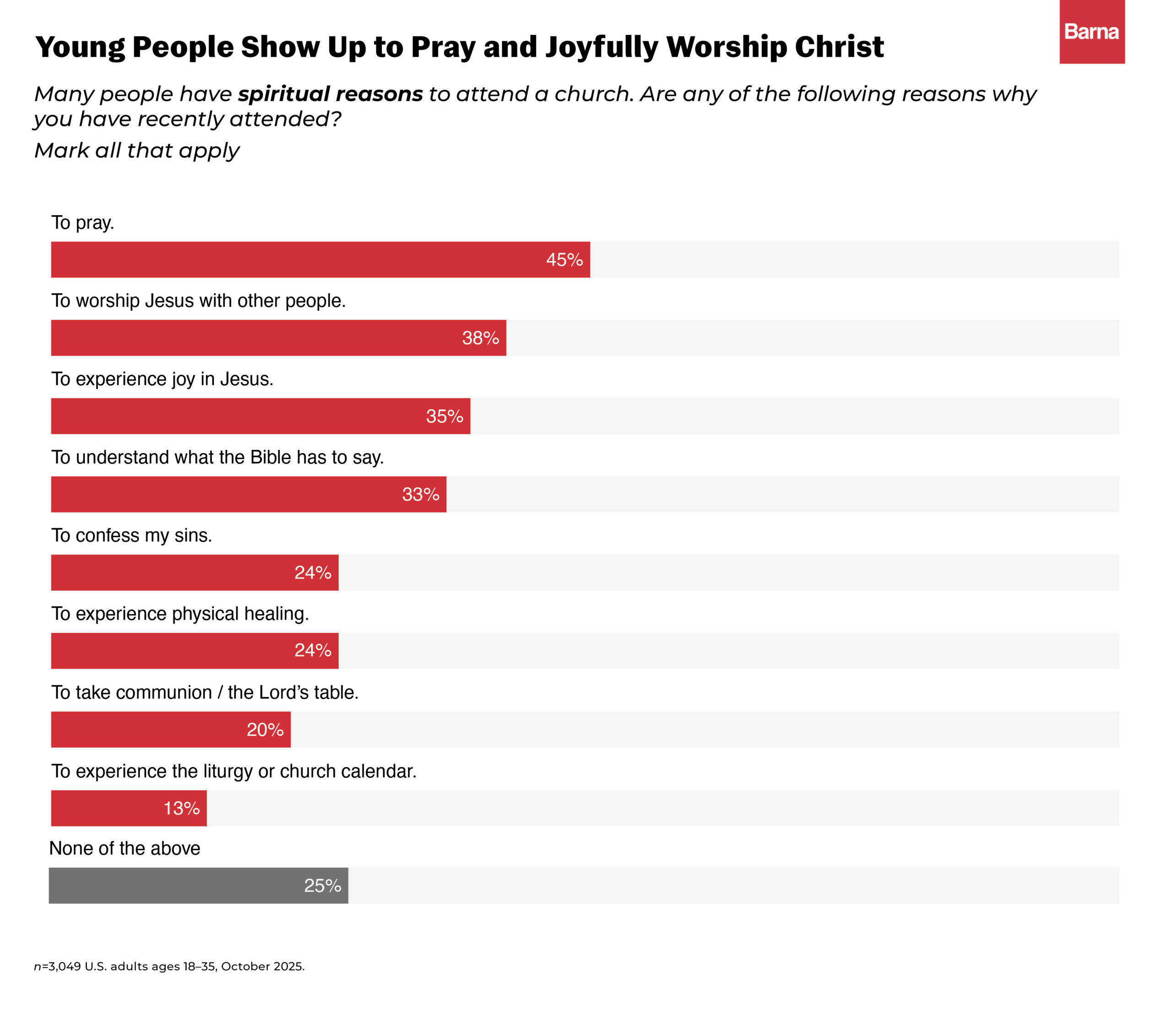
Notice all the church expectations. Turns out teens and young adults have some “churchy” expectations when they come to church. Research has backed up what I’ve been saying for my entire career. (Which has not always been popular.)
What was not around early in my youth ministry career was the internet, smart phones, apps, videos, podcasts, AI, AI companions, and what’s next? I’ve lived through it all, adapted awkwardly (I remember when copy machines made ministry easier!), and have continued to love young people in hopes that they will love Jesus.
With all these “helpful” tools, young people are not looking for church to become more like the internet. They can get content about God anywhere. They can follow Christian influencers. Listen to Christian podcasts. Watch sermons. Download Bible apps. Scroll through Christian TikToks and Instagram reels.
They can find content about God all day long.
But content about God is not the same thing as knowing God.
And this is where we have missed what young people are actually looking for.
They need sacred spaces.
They need safe adults.
They need people who will know their names.
They need intergenerational relationships.
They need people who will listen to their questions while giving space.
They need people who will teach them the Bible without treating them like children or projects.
They need a place where they can practice the way of Jesus with other people who are also practicing the way of Jesus.
They need ritualized times together. Not because ritual is magic but because relationship requires showing up.
You cannot build a community of people who are for you through content alone. You cannot learn how to forgive someone by watching a video about forgiveness. You cannot see how marriage works without seeing marriages in your relationships. You cannot learn how to belong by scrolling through a feed about belonging.
At some point, you have to actually belong somewhere. That’s where faith becomes more than content.
And here’s the amazing fruit of this. Those behavior-modification virtues that parents worry about do happen through church. Through prayer, worshipping Jesus with other people, experiencing joy in Jesus, understanding what the Bible has to say, confession of sins, experiencing physical healing, taking communion, and experiencing the liturgy. Those churchy things.
We want our teens and young adults to develop a faith that actually makes it into adulthood.
What if they grow from being with trusted people, investing into a community, being known, being loved, being challenged, being taught, being forgiven, being given responsibility and learning how to follow Jesus together? You know, all things found in church.
Not a production. Not a content delivery system. Not a bait-and-switch. Not another screen. Not a company with a financial incentive.
Because Freya India’s question is a good one. Are young people finding God? Or are they just finding content about God?
We see God through people. That’s how God has always designed his way to work. We meet people in church. Church comes with expectations like prayer and worship.
More Freya:
“Lately I’m beginning to feel as if Christianity has become another thing to do on my phone.”
Can we offer the real thing? And meet their expectations?
“It looks to me like the appification of Christianity is just the logical endpoint of its domestication, no?”
None of us want to follow a domesticated Jesus. Our souls are asking for more. The appification of our lives is damaging our souls. We want more. Jesus is the real deal and some challenge mixed in.
“Deep down I’m not convinced that’s what my generation even wants, not really. If you’re young and you weren’t raised religious and you find yourself drawn to faith surely it has to be because it’s different, because it’s a break from ads and notifications and discount codes. For the first time in our lives let us relate to something not as a consumer, please, I connect with everything this way, not God too.”
“Who knows, maybe in the future many of us will say we found Jesus through a YouTube Short, that God got recommended by our algorithm. But I doubt it. I think if Christians want to reach my generation, really reach us, they have to promise something totally separate from that, something otherworldly, something that doesn’t abide by market logic, something different, divine. Something, for once, that isn’t cheapened or commodified. And I hope some find the conviction to say that their faith is too complicated, too sacred, to turn into TikToks. If you want to know more about it, the subscribe button won’t help. You’ll have to step into church.”
Read the whole article. The Commodification of Christianity.
Let’s meet the expectations of what a church experience is. Please.